
Apple Pay is Live in the Philippines: What It Means for Digital Marketing and Local Commerce

Introduction
Context and scope of Apple Pay expansion
Apple Pay has expanded to the Philippines, enabling Apple device users to pay with a tap. The service supports iPhone, Apple Watch, iPad, and Mac, integrating with local banks and card issuers. This marks a significant step in bringing cashless options to more Philippine consumers.
- Frictionless checkout across iOS devices boosts conversion and average order values by reducing checkout friction.
- Banks and card issuers must coordinate with merchants to enable wallet provisioning and ensure NFC terminal and software readiness.
- Tokenization and biometric authentication protect card data; brands should highlight privacy and clear checkout steps to build consumer trust.
- Marketers should run education campaigns, promote wallet-backed offers, and align tracking to capture wallet onboarding and tap-to-pay attribution.
- Introduction
- 1. How Apple Pay Works in the Philippines
- 2. Banking and Retail Readiness for Apple Pay
- 3. Market Implications for Philippine Digital Marketing
- 4. Implications for Affiliate and Performance Marketing
- 5. Case Study: Banks and Merchants Rolling Out Apple Pay
- 6. Security, Privacy, and Trust in Apple Pay
- FAQ
- Conclusion
Why this matters to Philippine consumers and businesses
For consumers, Apple Pay offers a private, secure way to pay without pulling out physical cards. It simplifies checkout across online and in-store experiences. For businesses, the rollout creates new digital payment touchpoints that can improve conversion at the point of sale and enrich data-driven marketing opportunities.
- Faster checkout experiences across devices
- Broader acceptance of contactless payments at retailers
- Potential for enhanced customer trust through trusted payment methods
1. How Apple Pay Works in the Philippines
Supported devices and payment flows
Apple Pay supports iPhone, Apple Watch, iPad, and Mac users in the Philippines. You can add cards to Wallet on these devices and use tap-to-pay at compatible NFC terminals or complete purchases online in apps and on supported websites.
Payment requires user authentication via Face ID, Touch ID, or a passcode. Tokenization replaces card numbers with a device-specific token, so merchants receive an authorization without seeing actual card details.
Card issuers and banks participating locally
Local banks and card issuers connect to Apple Pay to enable wallet provisioning. The system supports major credit, debit, and prepaid cards, allowing cardholders to link existing accounts for quick payments.
Merchant onboarding hinges on participating institutions, ensuring smooth checkout experiences for both in-store and digital channels.
2. Banking and Retail Readiness for Apple Pay
Banks' adoption strategies and timelines
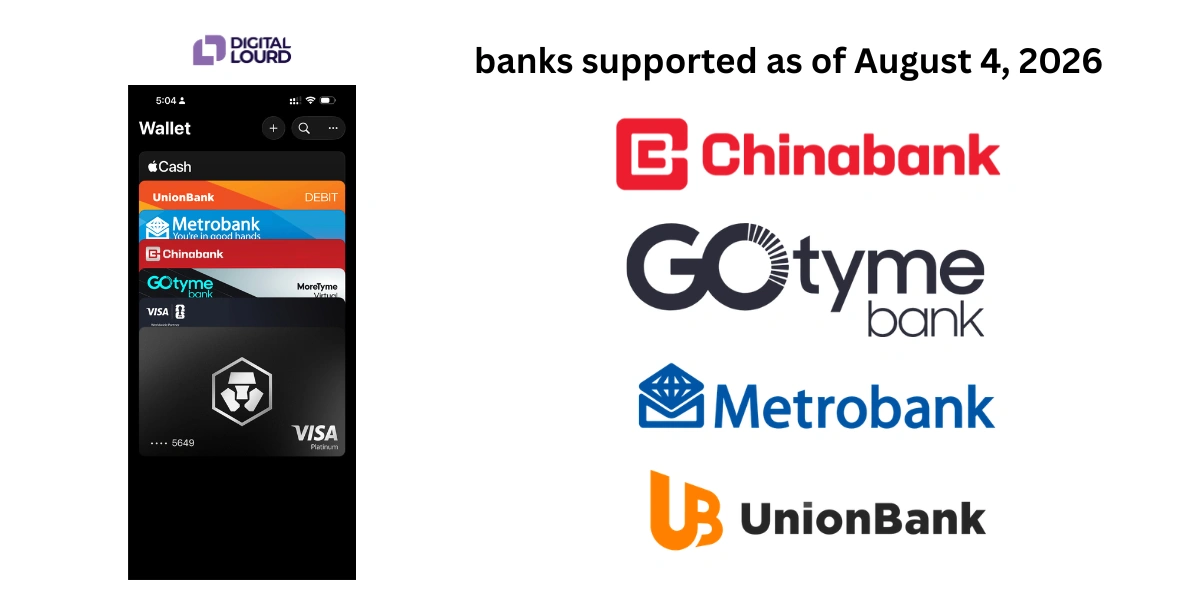
Philippine banks and card issuers are rolling out Apple Pay along a phased plan. Institutions are prioritizing high-volume debit and credit portfolios to establish wallet provisioning and card enrollment first.As of August 4, 2026, ChinaBank, GoTyme Bank, MetroBank, and UnionBank support Apple Pay. On October 6, 2026, Philippine National Bank (PNB) cards can already be added also.
Efforts center on simplifying onboarding, expanding card eligibility, and coordinating with Apple Payments Services LLC and local partners for support where applicable. Timelines vary by institution, with some introducing Apple Pay to existing customers first and others opening enrollment to new cardholders in waves.
- Targeted rollouts by bank tier and card type
- Co-marketed campaigns to boost wallet enrollment
- Regular updates to issuer networks as compatibility expands
Point-of-sale readiness and terminal compatibility
Retailers are upgrading to accept contactless payments through NFC-enabled terminals and updated software. Merchants can enable Apple Pay at checkout where supported by existing hardware.
Online and in-app checkouts are increasingly hosting Apple Pay as a primary option, with tokenization ensuring secure transactions. Routine firmware updates and software refreshes support readiness.
- NFC terminals enable tap-to-pay functionality
- Software updates align checkout flows with Apple Pay prompts
- Merchant onboarding with participating issuers is often required
3. Market Implications for Philippine Digital Marketing
Impact on contactless payment adoption and e-commerce
Apple Pay accelerates the shift to contactless payments across the Philippines. The familiar, trusted option aligns with iOS devices and local banks, shortening the path from awareness to purchase.
As Apple Pay gains prominence, both online and in-store experiences evolve. NFC-enabled terminals and updated apps reduce checkout friction, which can support higher conversion among mobile-first shoppers.
- Higher average order values as friction decreases
- Greater consistency between app and web checkouts
- Rising importance of mobile-first shopping campaigns
Opportunities for content marketing and education campaigns
Brands can run education-led campaigns about Wallet provisioning, tokenization, and where Apple Pay works best. Clear, practical guidance helps reduce hesitation for first-time users.
Content can emphasize privacy protections, trusted payment experiences, and quick onboarding tips to support merchant readiness.
- How-to guides for card provisioning on iPhone, iPad, and Apple Watch
- Short explainer videos on tap-to-pay versus online checkout
- Local case studies showing how merchants speed up checkout
4. Implications for Affiliate and Performance Marketing
Promoting Apple Pay-enabled offers and incentives
Highlight offers that reduce checkout friction through Apple Pay. Emphasize speed, privacy, and a seamless mobile experience to resonate with shoppers on iPhone, iPad, and Apple Watch.
Use creative assets that illustrate tap-to-pay in stores and streamlined online checkouts. Ensure messaging reflects Philippine consumer expectations and local banking partnerships.
- Showcase exclusive Apple Pay discounts or rewards when merchants run wallet-backed promos
- Offer quick onboarding tips for wallet setup to improve conversion
- Coordinate cross-channel promos that work in-app and on the web
Tracking and attribution considerations for new payment flows
Synchronize tracking across Wallet events, checkout tokens, and merchant receipts to capture the full impact of Apple Pay on online and offline sales.
Work with issuing banks and networks to surface relevant transaction data where allowed, while preserving privacy compliance for transparent affiliate reporting.
| Aspect | Best Practice | Impact |
|---|---|---|
| Attribution scope | Include wallet onboarding events and tap-to-pay activations | More complete view of funnel contributions |
| Data sources | Partner with banks, card issuers, and Apple Pay signals within privacy rules | Improved signal quality for optimization |
5. Case Study: Banks and Merchants Rolling Out Apple Pay
Key players and milestone events
In the Philippines, major banks and card issuers are aligning their ecosystems to support Apple Pay. Local financial institutions collaborate with Apple Payments Services LLC to enable card provisioning and wallet synchronization across iPhone, iPad, Apple Watch, and Mac devices.
Milestones typically include onboarding of banks, integrating with participating debit and credit cards, and expanding Apple Pay to retail and online channels. These steps aim to streamline checkout experiences and broaden acceptance across key consumer touchpoints.
- Bank onboarding timelines vary by institution and card issuer
- Merchant onboarding follows issuer support confirmation
- Retailers with NFC-ready terminals gain faster in-store adoption
What success looks like for local brands
Success is measured by reduced checkout friction, higher mobile conversion, and clearer attribution across wallets and purchases.
Local brands can expect enhanced customer trust through tokenization and privacy protections, alongside smoother cross-channel experiences.
- Faster checkout at physical stores with tap-to-pay
- Seamless online and in-app payments on iOS devices
- Improved analytics from integrated wallet events and checkout signals
| Aspect | Local Brand Outcome | Measurement |
|---|---|---|
| Checkout velocity | Quicker transactions at POS and online | Average time to complete purchase |
| Wallet adoption | More customers provisioning cards to Wallet | Number of cards added per month |
6. Security, Privacy, and Trust in Apple Pay
How Apple Pay safeguards consumer data
Apple Pay relies on tokenization and device-specific numbers to shield card data. When you add a card, the actual card number isn’t stored on the device or Apple servers. Instead, a unique device account number is created, encrypted, and kept securely in the device’s Secure Element.
Transaction details are minimized. Payment credentials aren’t shared with merchants, and payments require user authentication via Face ID, Touch ID, or a passcode. This setup lowers the chance of unauthorized use across online and in-store purchases.
Best practices for brands to communicate security benefits
- Highlight tokenization and privacy protections in messaging and creative assets
- Explain user authentication steps clearly at checkout to build confidence
- Showcase compatibility with major banks and card issuers to reinforce legitimacy
FAQ
What is Apple Pay in the Philippines?
What devices and payment flows does it support?
Which banks and card issuers participate?
How does Apple Pay protect security and privacy?
Can I use Apple Cash in the Philippines?
Will I need to update iOS or iPadOS to use Apple Pay?
What about merchant acceptance at local retailers?
Conclusion
Apple Pay’s rollout in the Philippines signals a tangible shift in how Filipinos pay, combining privacy oriented security with convenient, device based authentication. The change widens payment options for both shoppers and merchants, aligning with broader digital wallet adoption across the region.
For marketers, Apple Pay adds new touchpoints to explain quick, secure checkout and to integrate wallet based experiences into buying journeys. The focus should be on practical guidance that helps consumers see where Apple Pay fits into their everyday commerce.
Key takeaways for local brands:
- Highlight faster, frictionless checkout across in store and online channels
- Communicate clear privacy protections and tokenization benefits
- Coordinate with banks and issuers to support smooth wallet provisioning for customers
References
- Apple Pay in the Philippines? : r/Tech_Philippines - Reddit
- Countries and regions that support Apple Pay
- Apple Pay has expanded its contactless payment service to the ...
- Apple Pay is officially in the Philippines And here are the things ...
- Apple Pay participating banks and card issuers in Asia-Pacific

Vince is a digital marketing specialist, event host, and content creator based in Davao City, Philippines. Known for blending creativity, communication, and strategy, he helps brands and organizations strengthen their digital presence through compelling content and smart marketing practices. He specializes in SEO, content creation, social media management, pay-per-click advertising, and email marketing—turning ideas into content that builds visibility and helps businesses grow online. Outside of work, he loves to watch Netflix on weekends.