
How to get your content cited by AI Search Engines by employing Generative Engine Optimization (GEO) strategies?
Last Updated on July 1, 2026 by Lord Vincent Van Mendoza
- Answer user intent first with concise, conversational responses and clear structure to improve AI readability and citation likelihood.
- Build credibility with reputable citations, expert authors, original research, and frequent updates so AI trusts and references your content.
- Use structured data, fast mobile pages, crawlable content, and monitor AI citations and brand mentions to measure GEO success.
Quick Answer: What is Generative Engine Optimization (GEO)?
Generative Engine Optimization (GEO) is the practice of optimizing website content so AI-powered search engines like ChatGPT, Google AI Overviews, Perplexity, and other Large Language Models (LLMs) can easily understand, trust, cite, and reference it when generating answers. Unlike traditional SEO, which focuses on ranking webpages, GEO aims to position your content as the trusted source that AI systems use to answer users’ questions.
A successful GEO strategy prioritizes user intent, conversational writing, clear content structure, factual accuracy, and credibility. It also includes schema markup, strong technical SEO, and regularly updated content to improve AI visibility and increase the likelihood of being cited across generative search platforms.
In short: Generative Engine Optimization (GEO) helps your content become the authoritative answer that AI search engines recommend—not just another webpage in traditional search results.
Artificial Intelligence is transforming the way people search online. Instead of clicking through ten blue links on a search engine results page, users are increasingly receiving direct answers from AI-powered search experiences such as ChatGPT, Perplexity AI, Google AI Overviews, Microsoft Copilot, and other Large Language Models (LLMs).
This shift has introduced a new discipline known as Generative Engine Optimization (GEO).
With the rise of Generative Engine Optimization (GEO), will SEO become dead?
— Lord Vincent Van Mendoza (@digitallourd) June 26, 2026
Rather than competing solely for rankings, GEO focuses on making your content the authoritative source that AI systems cite and reference when generating answers.
If traditional SEO was about earning clicks, Generative Engine Optimization is about earning trust.
What is Generative Engine Optimization (GEO)?
Generative Engine Optimization (GEO) is the practice of structuring, writing, and optimizing content so that AI-powered search engines favor, cite, and reference it when generating responses. In essence, this is similar to Answer Engine Optimization (AEO).
The objective isn’t simply to appear on Page One.
The goal is to become the answer itself.
As AI assistants synthesize information from multiple trusted sources, websites that demonstrate authority, clarity, and credibility have a much greater chance of being referenced in AI-generated responses.
Why GEO Matters
The search landscape is evolving rapidly.
Users are asking longer, more conversational questions, and AI engines are responding with synthesized answers instead of lists of websites.
Businesses that fail to adapt risk losing visibility—even if they continue ranking well organically.
Generative Engine Optimization helps brands:
- Increase visibility in AI-generated answers
- Build authority beyond traditional rankings
- Improve trust with users
- Future-proof their content strategy
- Capture traffic from emerging AI search platforms
Instead of chasing clicks alone, GEO focuses on becoming the source AI trusts.
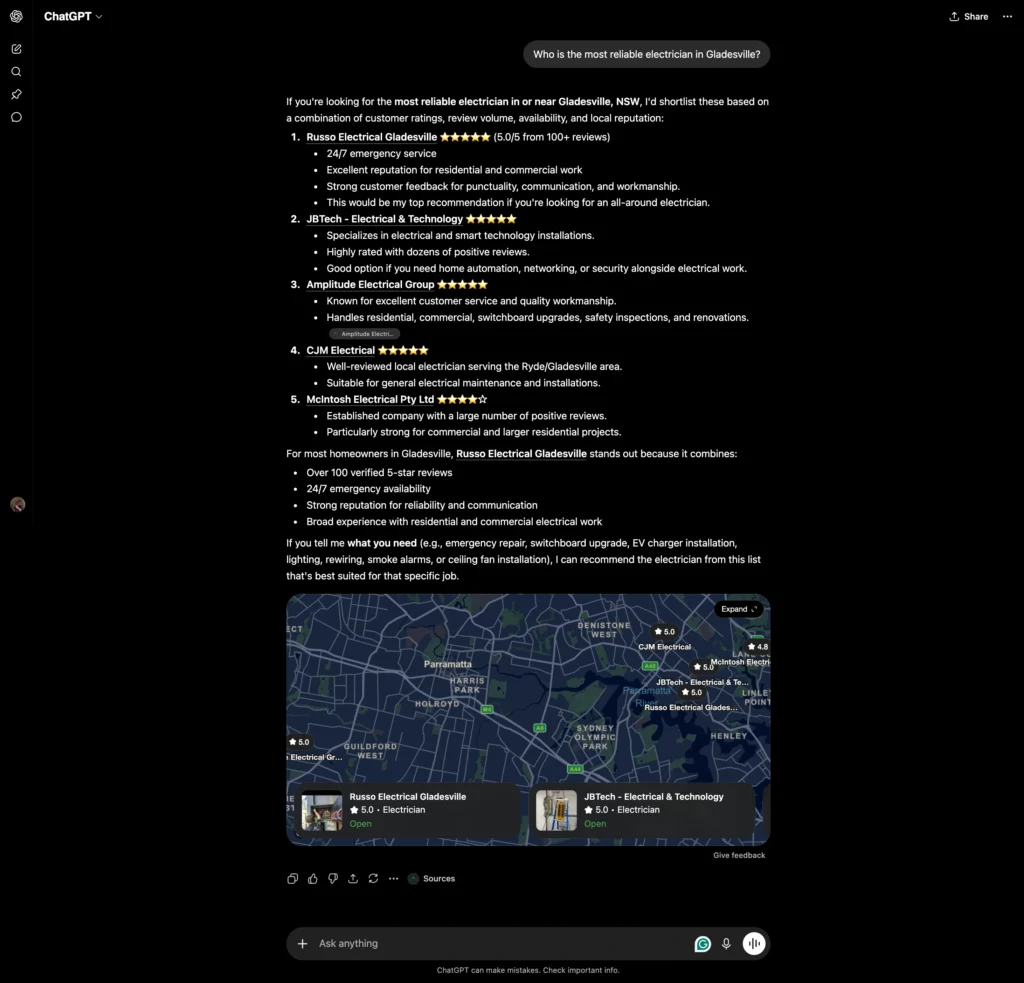
Have a look at this example. For the AI prompt, “Who is the most reliable electrician in Gladesville?“, my client, Russo Electrical is getting cited.
Generative Engine Optimization Strategies
1. Optimize for User Intent Instead of Keywords
One of the biggest changes GEO introduces is moving away from keyword stuffing.
Large Language Models understand language semantically, meaning they recognize intent, context, and relationships between topics.
Instead of writing for: “best CRM”
Write for questions like:
- What is the best CRM for a bootstrapped startup?
- Which CRM is easiest for small businesses?
- What CRM should a growing SaaS company use?
Answer First
AI prefers direct answers.
Begin every important section with a concise response before expanding into explanations.
For example:
Question: What is Generative Engine Optimization?
Better Answer:
Generative Engine Optimization is the practice of optimizing content so AI-powered search engines reference it when generating responses.
Then continue with supporting details.
This “answer-first” format significantly improves AI readability.
2. Write for Conversations
People no longer search the way they did five years ago.
Instead of typing:
SEO tips
They ask:
How do I improve my website’s visibility in ChatGPT?
or
What’s the difference between SEO and GEO?
Create content that mirrors natural conversations.
Some ways include:
- Question-based headings
- Conversational language
- Complete answers
- Contextual examples
- Natural transitions
This aligns closely with how LLMs interpret prompts.
3. Cover Multiple Search Intents
Modern AI tries to satisfy several user intents simultaneously.
Your content should address:
Informational Intent
Explain concepts thoroughly.
Example:
- What is GEO?
- How does it work?
Comparative Intent
Compare competing solutions.
Examples include:
| Topic | Comparison |
|---|---|
| GEO vs SEO | Differences and similarities |
| ChatGPT vs Google AI | Search behavior |
| AI Search vs Traditional Search | User experience |
Transactional Intent
Offer the next step.
Examples:
- Request an SEO audit
- Schedule a consultation
- Download a checklist
- Contact your agency
One comprehensive page can satisfy multiple intents at once.
4. Structure Content for Large Language Models
LLMs process structured information more effectively than long, unorganized text.
Use:
- Clear H1, H2, and H3 headings
- Short paragraphs
- Bullet points
- Numbered lists
- Summary tables
- Step-by-step instructions
Instead of writing a massive block of text, organize your content into logical sections that AI can easily parse.
5. Add Frequently Asked Questions Throughout the Page
Rather than placing all FAQs at the bottom, distribute them naturally throughout the article.
Examples include:
Frequently Asked Questions
Is GEO replacing SEO?
No. Generative Engine Optimization (GEO) complements traditional SEO by optimizing content for AI-generated search experiences, while SEO continues to improve visibility in conventional search engine results.
Does Google AI use websites as sources?
Yes. Google AI Overviews frequently reference trusted, authoritative websites when generating responses. Publishing accurate, well-structured, and expert-led content increases the likelihood of being cited.
Can small businesses benefit from GEO?
Absolutely. Small businesses that consistently publish helpful, trustworthy, and experience-based content can earn citations in AI-generated answers, regardless of their company size.
Why should I include FAQs in my content?
Distributed FAQ sections help capture additional conversational search queries, improve topical depth, and make content easier for both users and AI search engines to understand and reference.
6. Build Trust and Authority
AI engines prioritize content that appears credible and verifiable.
Some ways to strengthen trust include:
- Cite reputable studies
- Reference industry reports
- Include expert opinions
- Provide original research
- Publish case studies
- Use real statistics
- Include author biographies
Studies have shown that content featuring expert quotes and supporting data can achieve significantly greater visibility in AI-generated responses.
Trust is becoming the new ranking factor.
7. Keep Content Updated
Freshness matters.
AI systems increasingly prioritize recently updated information.
Best practices include:
- Display a visible “Last Updated” date.
- Refresh statistics regularly.
- Update screenshots.
- Replace outdated references.
- Review evergreen content every few months.
Consistent maintenance signals ongoing authority.
8. Implement Structured Data
Schema markup helps search engines and AI systems understand your content.
Consider implementing:
- Article Schema
- FAQ Page Schema
- Author Schema
- Organization Schema
- Breadcrumb Schema
- Review Schema (where appropriate)
Structured data provides machine-readable context that improves discoverability.
9. Improve Technical SEO Foundations
Generative Engine Optimization still depends on solid technical SEO.
Key recommendations include:
- Fast page speed
- Mobile-friendly design
- Clean HTML
- Internal linking
- Crawlable architecture
- Server-side rendering where applicable
Some AI crawlers struggle with heavy JavaScript, making server-side rendering an effective solution for ensuring content remains accessible.
10. Monitor AI Visibility
Traditional SEO metrics are no longer enough.
Track:
- AI citations
- Brand mentions
- AI referral traffic
- Sentiment analysis
- Prompt visibility
- Citation frequency
Enterprise platforms such as Semrush Enterprise AIO and other emerging AI visibility tools can help measure how frequently your brand appears in AI-generated responses.
Success is no longer defined solely by rankings.
It’s measured by whether AI chooses your content as a trusted source.
One way of checking AI Visibility is by using an SEO tool like SERanking.
The Human + AI Content Strategy
Many marketers now embrace a hybrid workflow.
AI can help generate drafts, outlines, and ideas.
However, human expertise remains essential for:
- Fact-checking
- Original insights
- Personal experience
- Expert opinions
- Data interpretation
- Storytelling
The highest-performing GEO content combines AI efficiency with human credibility.
This balance produces content that is both scalable and trustworthy.
GEO vs Traditional SEO
| Traditional SEO | Generative Engine Optimization |
| Optimizes for rankings | Optimizes for AI citations |
| Targets keywords | Targets prompts and conversations |
| Focuses on backlinks | Focuses on authority and trust |
| Measures clicks | Measures AI visibility |
| Optimizes SERPs | Optimizes AI-generated answers |
The two disciplines work best together.
Traditional SEO helps users find your content, while GEO helps AI understand, trust, and recommend it.
Generative Engine Optimization represents the next evolution of search marketing.
As AI-powered search experiences become increasingly common, businesses that produce authoritative, structured, and trustworthy content will gain a significant competitive advantage.
The future belongs to websites that answer questions clearly, demonstrate expertise, and earn the confidence of both people and AI.
Rather than optimizing solely for rankings, optimize to become the source AI chooses to cite.
That’s the true objective of Generative Engine Optimization.
If you need help with optimizing your digital presence, consult an SEO specialist today!
Frequently Asked Questions About Generative Engine Optimization (GEO)
Find answers to the most common questions about Generative Engine Optimization (GEO), how it differs from traditional SEO, and how to optimize your website for AI-powered search engines.

Vince is a digital marketing specialist, event host, and content creator based in Davao City, Philippines. Known for blending creativity, communication, and strategy, he helps brands and organizations strengthen their digital presence through compelling content and smart marketing practices. He specializes in SEO, content creation, social media management, pay-per-click advertising, and email marketing—turning ideas into content that builds visibility and helps businesses grow online. Outside of work, he loves to watch Netflix on weekends.